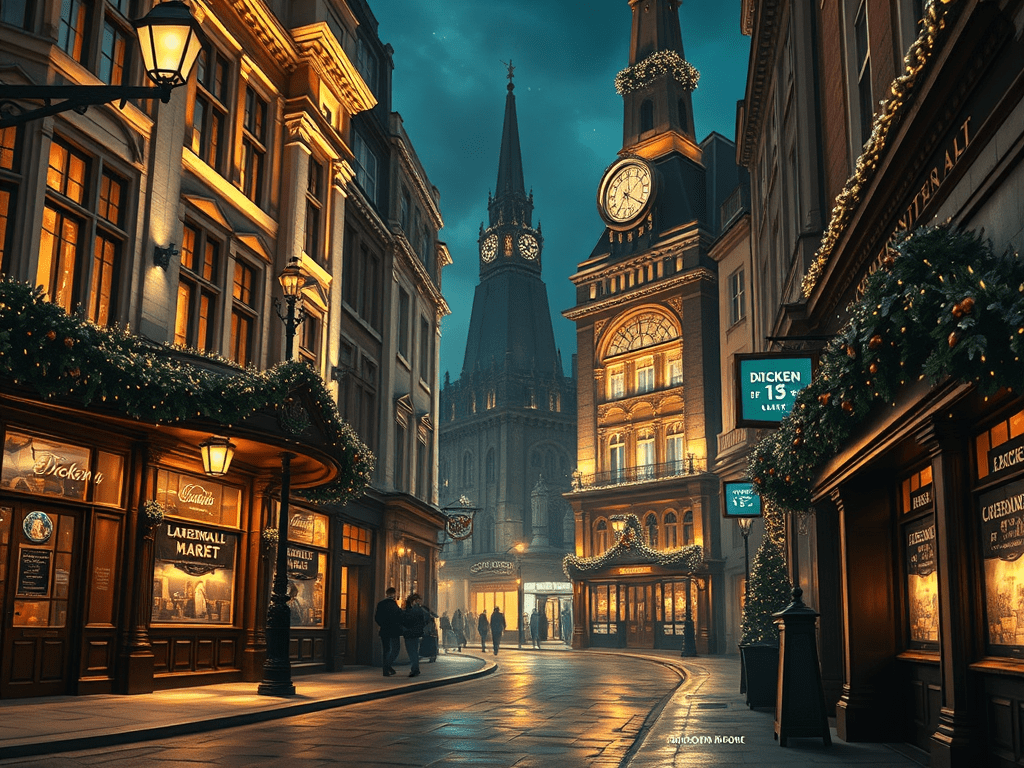
There is nothing better than having a walk in London in the evening at Christmas. All the lights are on and everyone is in a festive mood. With that in mind I set about planning a walk based on ‘A Christmas Carol’.
We started at Tower Hill tube station, mainly because that’s where I get in to London. From there it is a short walk to Lime Street/Lime Street Passage.
He lived in chambers that had once belonged to his deceased partner. They were a gloomy suite of rooms, in a lowering pile of building up a yard, where it had so little business to be, that one could scarcely help fancying it must have run there when it was a young house, playing at hide-and-seek with other houses, and forgotten the way out again.
It is possible as this is near Leadenhall Market that this is where Scrooge lived, as it is from such a place he sent a young boy to get the turkey.
The walk then continues into Leadenhall Market.
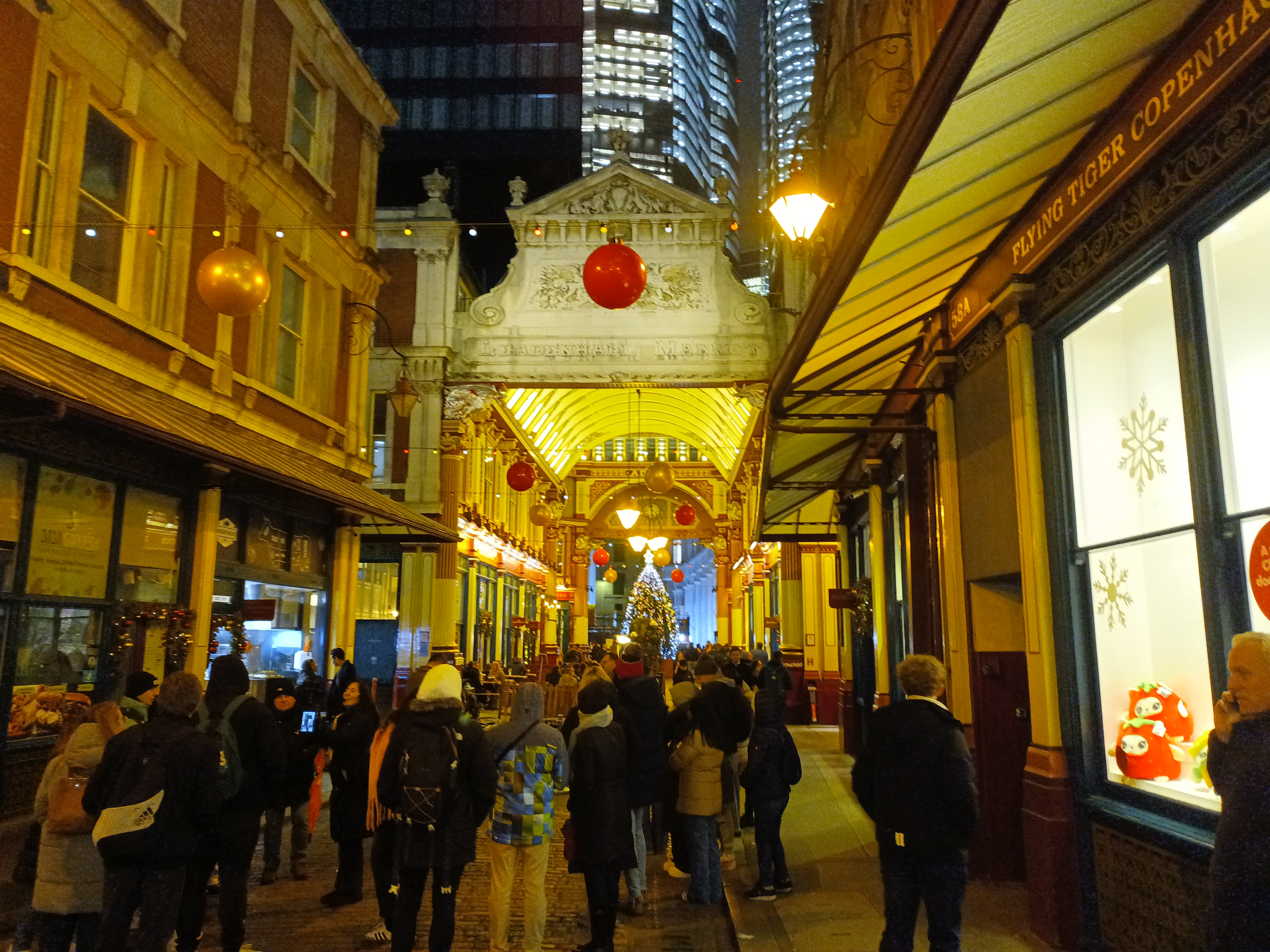
This is possibly where Scrooge sends the boy for a turkey, although there are other places on the walk where it could be.
“Do you know the Poulterer’s in the next street but one, at the corner?” Scrooge inquired.
“I should hope I did,” replied the lad.
From here it is a short walk to 35 Gracechurch Street, which is just beside the TKMaxx. This is an example of the Counting Houses that might have been around at the time.
Head a little further down Lombard Street and then right into George Yard. The George and Vulture pub here might have been the one that Scrooge was eating in but a better bet is Simpsons Tavern which we get to later. Head through the right most entrance to St Michael’s Alley and then right into Corbet Court followed by a left up St Peter’s Alley. Here you will find the churchyard of St-Peter-Upon-Cornhill which was a derelict burial ground in Dicken’s time. You can just imagine the Ghost of Christmas Yet to Come leading Scrooge here in a foggy murky London of that time.
The Ghost of Christmas Yet To Come conveyed him, as before—though at a different time, he thought: indeed, there seemed no order in these latter visions, save that they were in the Future—into the resorts of business men, but showed him not himself. Indeed, the Spirit did not stay for anything, but went straight on, as to the end just now desired, until besought by Scrooge to tarry for a moment.
“This court,” said Scrooge, “through which we hurry now, is where my place of occupation is, and has been for a length of time. I see the house. Let me behold what I shall be, in days to come!”
The Spirit stopped; the hand was pointed elsewhere.
“The house is yonder,” Scrooge exclaimed. “Why do you point away?”
The inexorable finger underwent no change.
Scrooge hastened to the window of his office, and looked in. It was an office still, but not his. The furniture was not the same, and the figure in the chair was not himself. The Phantom pointed as before.
He joined it once again, and wondering why and whither he had gone, accompanied it until they reached an iron gate. He paused to look round before entering.
A churchyard. Here, then; the wretched man whose name he had now to learn, lay underneath the ground. It was a worthy place. Walled in by houses; overrun by grass and weeds, the growth of vegetation’s death, not life; choked up with too much burying; fat with repleted appetite. A worthy place!
The Spirit stood among the graves, and pointed down to One. He advanced towards it trembling. The Phantom was exactly as it had been, but he dreaded that he saw new meaning in its solemn shape.
“Before I draw nearer to that stone to which you point,” said Scrooge, “answer me one question. Are these the shadows of the things that Will be, or are they shadows of things that May be, only?”
Still the Ghost pointed downward to the grave by which it stood.
“Men’s courses will foreshadow certain ends, to which, if persevered in, they must lead,” said Scrooge. “But if the courses be departed from, the ends will change. Say it is thus with what you show me!”
The Spirit was immovable as ever.
Scrooge crept towards it, trembling as he went; and following the finger, read upon the stone of the neglected grave his own name, Ebenezer Scrooge.
Heading across the Cornhill road, slightly to the left you can enter Newman’s Court. It was on Cornhill that Bob Cratchit slid down twenty times. Scrooges counting house might have been here, and strangely enough there is the Counting House pub over the road!
Head back across Cornhill and then down Ball Court passage. It is here that Scrooge might have been found eating in Simpsons Tavern.
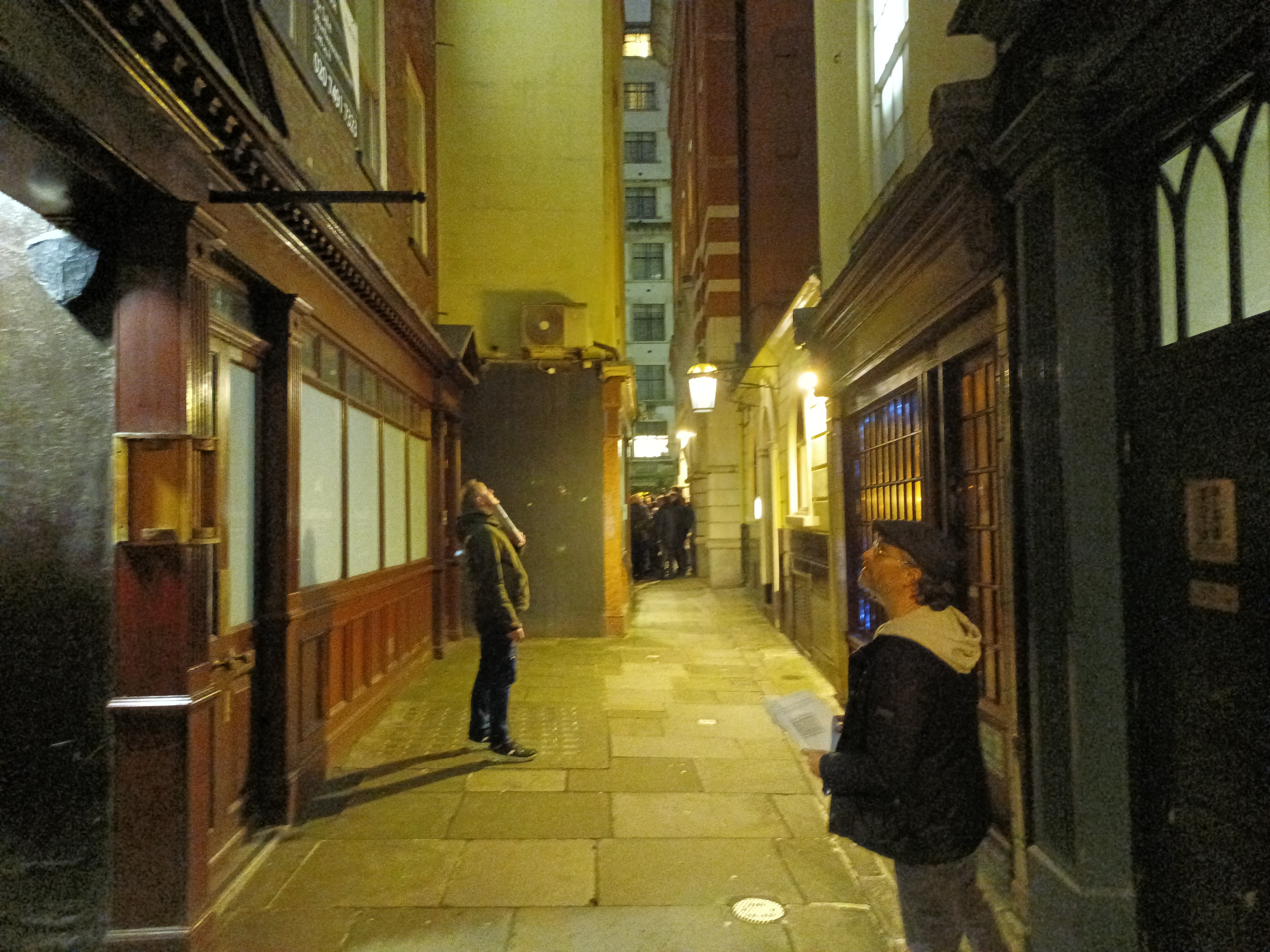
Scrooge took his melancholy dinner in his usual melancholy tavern; and having read all the newspapers, and beguiled the rest of the evening with his banker’s-book, went home to bed.
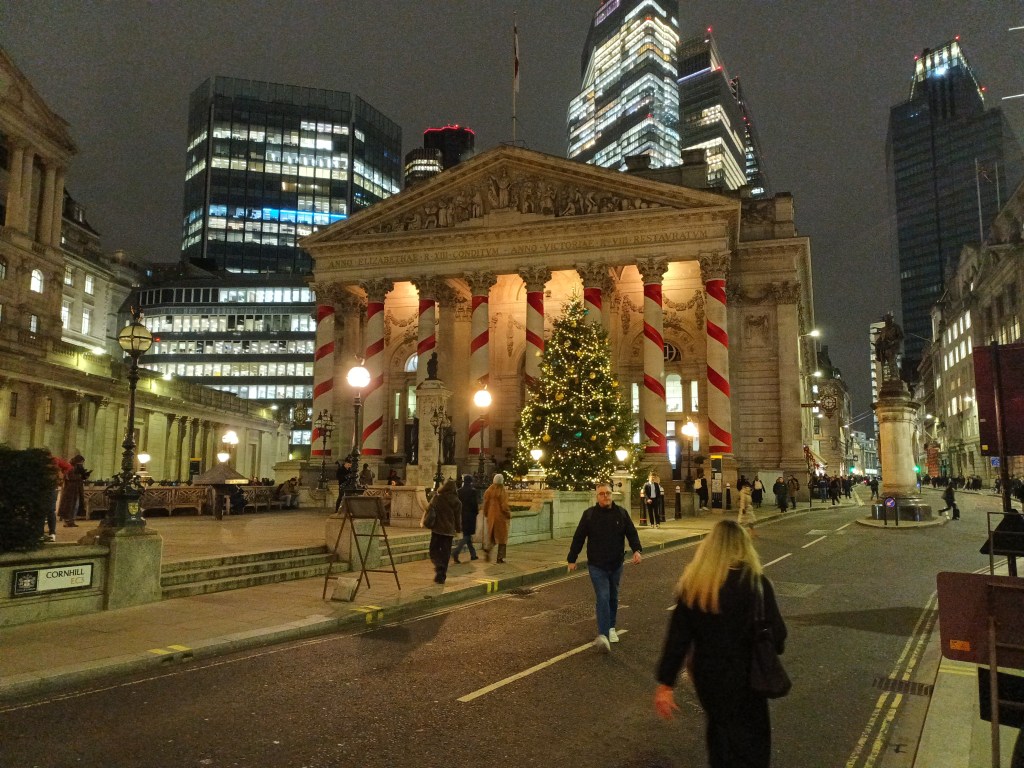
Head back onto Cornhill and turn left down to the Royal Exchange, this and Mansion House nearby are both mentioned in Dicken’s book.
Another place that could have been the one that Scrooge sent the boy to get the turkey could have been just a bit further on down Poultry and Cheapside. Cheapside would have been one of the main shopping streets in London during Dicken’s time.
The poulterers’ shops were still half open, and the fruiterers’ were radiant in their glory. There were great, round, pot-bellied baskets of chestnuts, shaped like the waistcoats of jolly old gentlemen, lolling at the doors, and tumbling out into the street in their apoplectic opulence. There were ruddy, brown-faced, broad-girthed Spanish Onions, shining in the fatness of their growth like Spanish Friars, and winking from their shelves in wanton slyness at the girls as they went by, and glanced demurely at the hung-up mistletoe. There were pears and apples, clustered high in blooming pyramids; there were bunches of grapes, made, in the shopkeepers’ benevolence to dangle from conspicuous hooks, that people’s mouths might water gratis as they passed; there were piles of filberts, mossy and brown, recalling, in their fragrance, ancient walks among the woods, and pleasant shufflings ankle deep through withered leaves; there were Norfolk Biffins, squab and swarthy, setting off the yellow of the oranges and lemons, and, in the great compactness of their juicy persons, urgently entreating and beseeching to be carried home in paper bags and eaten after dinner.
This is not a bad place to finish the short walk and head to any pub close by to get some food and drink.
However. You can continue on past St Paul’s Cathedral and through Holborn where Dickens once lived, Chancery Lane where Dicken’s may have worked as a law clerk and Gray’s Inn Road where Dickens also worked at Ellis and Blackmore.
Have a good Christmas all!

 Essex Man Does Walking
Leave a comment